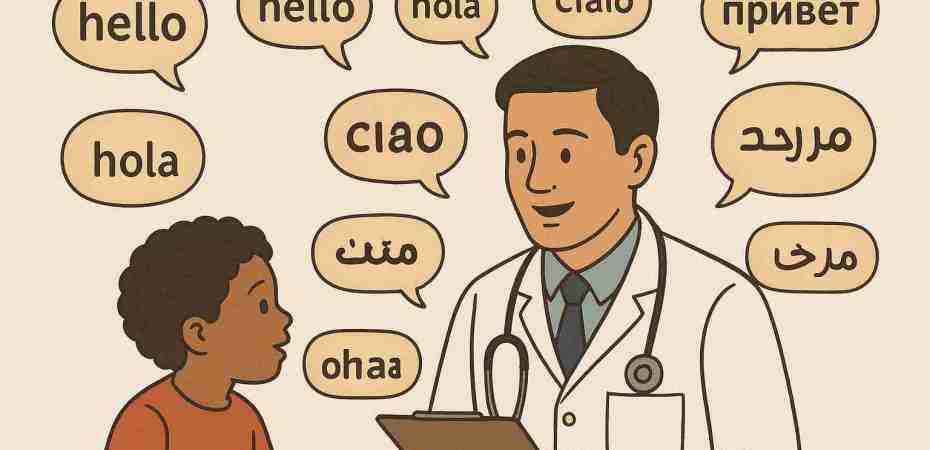
Almost a decade ago, while navigating the challenges of Medical School, I made the decision to become a Pediatrician. I remember sitting down to write my “Personal Statement” for Residency – something I had at the time already had to do for Medical School and since had to do for Fellowship. My “cover letter” of who I was needed to be tied together in some sort of cohesive manner to showcase why I desired and deserved this path, just as all medical specialties demand. I wrote about so many different cases I had come across but had no unifying theme until I realized one day that when I looked back on my life, I had something that tied my entire life together which is hopefully clear subtextually from this Blog: I’m a Linguist.
From kindergarten until my junior year in high school i was fortunate enough to learn Spanish. I passed the AP Spanish test in high school and skipped past the college requirement for any language study, but, due to boredom and curiosity, chose to study Italian. After a year and a half of learning Italian, I moved to Italy to become certified as an “English as a Foreign Language” teacher and when I returned to the US then went on to study Russian for over a year prior to moving on to Medical School. Throughout these more formative years, I also picked up bits of Farsi, a word here or there in German, and occasionally a tiny sprinkling of French. Then, in 2013, I relocated from my birth state of California to New Orleans, Louisiana.
“Where do you stay?” “I’m going to make groceries.” “Where did you go to high school?” I remember one of the first few days getting oriented to medical school that among some of the instruction on the first few steps of becoming a Physician when we had a lecture from one of the professors on something completely non-medical: Understanding New Orleans. He described that things were said differently in New Orleans, street names were pronounced unlike they were spelled, people had phrases that we may have never heard, and of course, an unfortunately large percentage of the community had barely a 7th grade education level. It altered me, changed the way I heard words coming out of my mouth, and has shaped me into the Physician I am today.
While I’m not perfect by any means, I have learned to alter my word choice depending on who I’m talking to, to convey a message beyond the medical vernacular and beyond the literal text. I am conscious that I now speak a completely different language in the office, and out on the floor I try my best regardless of if i’m talking to a family in English or Spanish, to translate what I know into words that make sense.
As I have gotten older, I have made this dialogue more nuanced. I try often to ask parents what they do for work, one to understand their social situations and the barriers to my giving them adequate care along with obstacles that might be faced once they go home. I don’t “dumb” things down since I find this to be a derogative way to describe the process, but I try to meet someone eye to eye. I learned a long time ago that a person with only a 7th grade language will hear me differently than one with a graduate degree. Asking how a person wants to receive information is vital to translations.
One night, this became extremely clear to me when a father of two very sick very small premature twins (that ultimately after months hit their milestones and went home) asked me questions about the ventilator. He asked details about mechanics that I don’t typically get asked, so I reverberated back a different question, “Do you mind if i ask you what you do for work?” “Engineer.” So many things clicked into place as he said that. I began to see him for him and hear how he understood the world. He went on to tell me details of what he did and how he processed things very analytically. He worked with processing, he worked with systems, he worked in circuits. I stepped back, I thought about his question on the ventilator, and I responded in analogies and connections that fit that request and he looked at me and finally said, “Ah, that makes sense.”
Learning to speak has been a continual challenge throughout my life and should be something that we all focus on, but particularly those of us that practice medicine. I remember just the other day talking to a friend of mine that i only see in the world of Country Line Dancing as he told me about his newest grandchild in the NICU. He described what was going on and what he interpreted from what the doctors and nurses said. I was quiet, and I hid in plain sight not telling him what I did, just listening to his description. I translated his non-medical descriptions in my head back into medical vernacular, “He’s forgetting to breathe” (Ah, he has apnea of prematurity), “His blood sugar was lower at first” (Of course, he’s hypoglycemic), “He has jaundice” (Indirect hyperbilirubinemia)… I have still never told him what I do for work and if he stumbles upon it someday maybe i’ll translate it back, but it was clear to me that someone out there had done a great job themselves of being an interpreter for Medicine.
I am constantly reassessing, reflecting, and rethinking what I say and as importantly, how i say it, and I encourage everyone to do the same. I am a Pediatrician to take care of children, but the Linguist part of me has learned how to translate the things I’ve spent decades learning, into words that are understood.
The Art of Medicine is neither inferior nor superior to the Science of Medicine.
Image Credit: ChatGPT
 The Nomadic Pediatrician