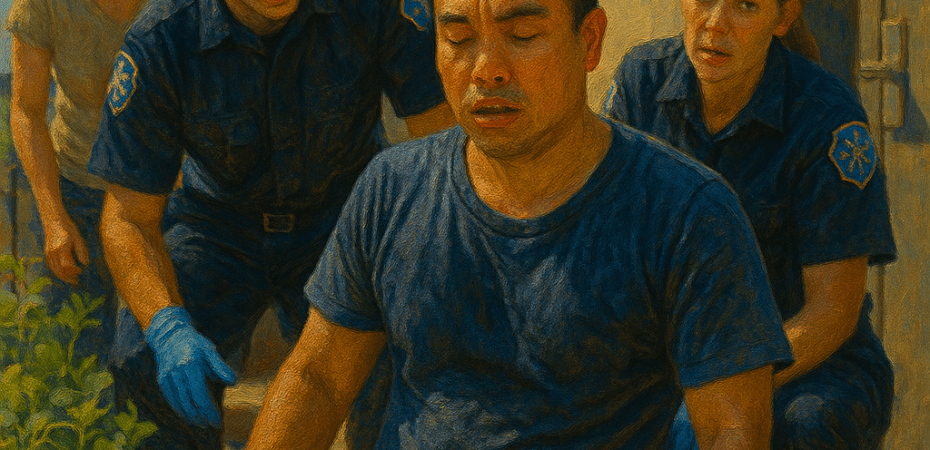
I remember waking up, sitting on the ground in my little planter box garden, confused and dizzy. My shirt was drenched, the sun glaring down at me, and I could hear the voices of my best friend and his wife as the world fish bowled back into existence. I heard the door to the garden open and my senses started to slowly creep back as EMS rushed onto the roof.
“Hey, are you ok?” “Yeah, sure, why are you asking? I don’t get it.” “…you just had a seizure…” “What, no I didn’t, you’re wrong. What?” “Well, why are you sitting on the ground then?” “Oh, I got tired, obviously.” “… No, hey, you had a seizure.” “….. What?…. Oh…. I don’t believe you.”
It was the oddest experience reciting my medical history to the doctor in the Emergency Room that day. I could hear so many patients before me saying similar things and simultaneously, I didn’t want to be one of those patients that all of us in the medical community are fond of that… Think they know everything or… had “done their research.” I had never had a seizure before, and I’d been to the ER only once ever during which everything had been normal years ago, so this was odd. A true witnessed seizure; my friends were great historians because I had been fortunate enough that another woman working on her neighboring garden had had a child with seizures and knew exactly what to do, exactly what to remember for my HPI or “History of Present Illness.”
At this point it had been over a decade since I had started medical school and the words of my former professors stuck with me: I could hear the echos of lectures past that there were certain medications that could lower your “seizure threshold” and put you at a higher risk for these things. I got the whole work-up of course, labs, a CT scan followed by an MRI, and a nice night of observation. The hospital had been so full that I even got the luxury of being stuck in the emergency room for the entirety of my time there and in the morning when I spoke to the Neurologist, she chalked it up to my medication, told me obviously to stop taking it, and I went on my merry way with a follow-up in a few months outpatient.
I have tried and we all do very often to put ourselves in the shoes of our patients. By specializing in Pediatrics and further into the world of Neonatology, as someone without children, it’s almost impossible for me to really understand my families. I try my best and I’m always conscious of trying to be empathetic. The complex situations I face even beyond the simple aspects of having offspring further complicate the process for the rare diagnoses and unfortunate or untimely situations that we come across and can’t control. It really isn’t until we look in the mirror and see ourselves as the patient that we get it, and it was a humbling reminder to do this more often.
It is impossible to truly “know” or “understand” what any other human is going through and I am diligent in my conversation to avoid these words as often as I can; however, I have come across situations and patients with similarities and offer the perspective of anecdotal patterns. I finally feel what it means to be postictal (confused after a seizure)… I finally feel the fear and feel the emotions that so many have tried to describe to me… Every experience is different but I feel closer in solidarity to so many of those I have counseled before and so many I will hopefully come across to help in the future.
When the doctor becomes the vignette, you realize, we are also Simply Human.
P.S. Ironically as I wrote this post, I was having borderline anaphylaxis at my allergy appointment requiring an EpiPen… So, there’s that. Too much humanity/humility all at once.
Image Credit: ChatGPT

