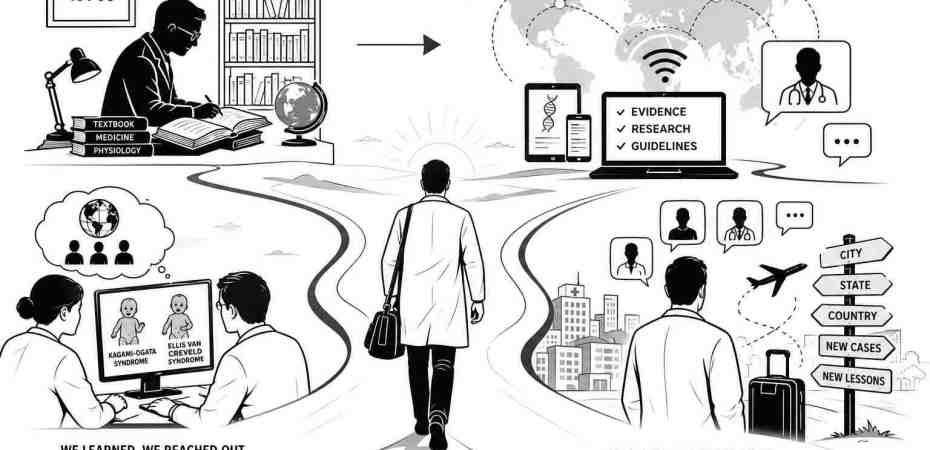
After almost a decade of being a Physician, I have experienced a variety of training and working atmospheres that have helped to mold the way I interpret science, interact with patients, and practice medicine. Throughout the last several decades, the explosion of research and technology along with the ease to find information along the international information highway at the click of a button, has changed the entire field of Medicine at a rate that may arguably outpace other disciplines in the world. In the 1970s, when my father was going through his medical training, there were libraries, there were books, and that was it. The amount of information we knew was less but the access we had to it was even more restricted. A single patient or case that had the incidence of 1 in 1,000,000 was something you may have never known existed your entire life, especially if by chance it came up on the other side of the planet where it was almost unheard of being able to travel to at a whim. Humanity had barriers in dissemination of medical information and science that we overcame in drastic ways, and I personally feel people don’t have enough respect for the transition.
Flash forward… Where are we now?
Not only is it possibly to jump on a plane to travel across oceans thousands of miles to other places, but communication happens at lighting speeds via the world wide web, and is only becoming faster. Databases are exploding and incomprehensible rates and we are discovering more with new technology at a rate that dwarfs humanity’s most farfetched themes a century ago. If we come across something we’ve never come across before in our small bubble, whether at a rural or urban level, we can reach out to someone for more advice at the drop of a dime. If they don’t know, they reach out further, and so on. In my Fellowship Training to become a Neonatologist, we had a single little baby with Kagami-Ogata Syndrome (Uniparental Disomy 14) and another with something called Ellis Van Creveld Syndrome – two conditions for which the collective experience of ~30 neonatologists at our quaternary care institution gave no clear prognosis (a.k.a. outcome) and the management was part of the large abyss of the unknown the public forget we battle daily in medicine, even despite artificial intelligence. So, what did we do? We reached out to other cities, other states, and even other countries for advice, and found very limited reports and evidence throughout the world on what to do with our small cases, but we did find something, and both of those babies went home, alive, well and smiling.
It is often and most commonly recommended that after completing medical training, particularly in sub-specialty/fellowships in the specialty of Pediatrics, that you seek out a home to continue growing and learning. After all, we call working in Medicine as a Physician, a “practice,” because, you never truly become a master and it is a life-long learning experience that consumes you. However, it is always a curious thought… If you have completed training, why do you need to restrict yourself to stay at a place that continues to work on training others? Why are you NOT prepared to leave the nest, so to speak… I was honored when my own personal Allergy doctor said to me, when at a simple allergy shot appointment, I divulged to her my frustrations with mentorship, “Wait… Why are they concerned about you going out into the world? Why are they worried about you going to do locums? Psh, if anything, that’s kind of insulting, don’t ya think? Like…. They’re basically saying, they didn’t train you well enough?” I paused.
There is a lot of thought and controversy for another post and from my head on the experience of training a physician and due to the failure of it’s creation, there are currently discussions on altering the way it happens; but, she had a valid point.
I was a Pediatrician when i started this blog and i would often consult with others for help… Now, I am a Neonatologist, and now I am the one that is being consulted. It is unlikely in a lifetime that even working 50 years i would see everything and every rare case that there is in the world of medicine. Many argue, that being somewhere with high volume or high referral rates increases those odds; and, while, I don’t quite dispute that, I don’t preference being the expert at the 1 in 1,000,000. I preference saving the masses and understanding my role and position are just as needed as the specialist that takes care of the 100 solitary patients in the world with a rare diagnosis.
It is rare to have a mentor in academic/urban settings support the movement towards working in locum tenens and traveling for work… That is changing. However, in 2020, I was fortunate enough to meet Dr. Jose Garcia, a Neonatology Attending with decades of experience including years spent traveling with the Army. He once told me a story as i neared graduation and told him of my unconventional path, that he once, in Germany, took care of a baby with an abnormal and rare skin condition… It was related to something called “Protein C Deficiency.” He told me years later, when he turned to the United States, a junior attending, that he again came across a similar rash, and immediately his neurons were excited and he exclaimed once again, “That’s Protein C Deficiency! I’ve seen it before!” He was laughed at, but he was right.
I am a strong believer that there are a million ways to answer certain questions, that there are endless ways to be successful, and again, that the concept of thinking outside of the box is only relevant if you think there’s a box at all. I understand the concern and the thoughts to focus my continued education at a facility with high volumes to increase my odds of seeing complicated cases, rare cases, or honing particular skills through repetition. But, why can it not be done by traveling and locums and instead seeing variety?
Locum tenens has taught me something powerful and made adaptation a second nature for me… It has taught me that, Medicine is Medicine is Medicine… No matter where you go. I could be wrong, I could regret the decision to learn from variety and diversified exposure over stability at a single institution with a high volume… But, I could also, be right.
Image Credit: ChatGPT


I can see the beauty on both sides. Creating a medical home and establishing connections with families brings joy and a sense of belonging; at the same time diversifying and exploring different locations also allows exposure to different population, culture and that changes the medical picture as well, I believe making you more “well rounded”. I have stayed put as you know and I had the pleasure of caring for a sweet patient with Ellis Van Creveld Syndrome from birth to 6yo and now I’m ready to explore and expand-Ultimately, I think, being flexible, open minded and willing to grow it what matters most.
LikeLike