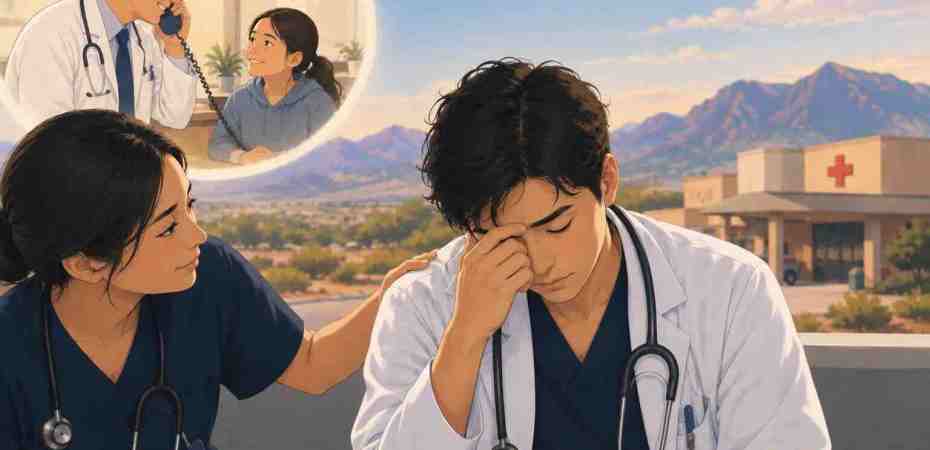
It was the second day of my very first job as an Attending Neonatologist working ten consecutive days of call (240 hours in a row of rounding and then being available for emergencies from the hotel) in Las Cruces, New Mexico, when I woke up with excruciating right eye pain that knocked me out of bed at 5AM. At first, I tried not to think too much of it, maybe i laid on something, or scratched it, or got some sand in it from going to the White Sands National Monument the day before. But, this was different.
In a town of only ~117,000, states away from where I was in-network with my medical insurance and all of the other medical connections I have been privy to as a physician, I found myself not only at a loss of where to go, but also where to even begin as a Patient, just like anybody else. Nervous and concerned for what was going on, I drove in to the hospital and went straight to the emergency room where, just a few days before, I had introduced myself to the ER Attending as the new Neonatologist – the one kind of doctor we both hoped she would rarely need to consult in the Emergency Room. I remember walking into the workspace, scrubs and badge making me look like I belonged in this foreign land, knocked on the door and, again, re-introduced myself and pleaded for help. She was calm, and told me to go to the first room, while she activated a CODE STEMI (heart attack) at the same time.
I went into the front room and waited, and shortly after she came and examined my eye and did a few tests trying to figure out what might be going on. The presumptive diagnosis was potentially an infection, but it was hard to tell, and there weren’t any Opthalmologists on-call for our hospital… It was too small, and we were in a literal and also medical desert. I was nervous, my eye red, burning and feeling as if I had just gotten in the worst bar fight of my life. She prescribed some antibiotic ointment, I said thank you profusely as we talked about what had led both of us to this small ER in New Mexico, and she responded, “Of course. Don’t worry about it. What I like about this place and how small it is, is we take care of our own.”
The next day the pain continued and got worse with development of photophobia (worsening pain to light) and without any drainage, I wasn’t sure If I could say that there was an infection i was sure i was fighting, despite the antibiotic ointment. Throughout the day, it became relentless and I texted a former Nurse Practitioner I had once worked with years ago that lived in Las Cruces, and she told me with how long the waits were to get into the eye clinics, it might be best to just ask around for connections. So, I did.
Somehow, being in the right place at the right time, or maybe the right place at the wrong time in this case, I found out that one of the Midwives on my floor had previously worked in an Eye Clinic, she pulled some strings, texted some friends, and in less than 6 hours I found myself seeing a kind Optometrist that quickly diagnosed me with Anterior Uveitis – an inflammatory eye condition. “You know the right person. Did you know, [that midwife] used to work here in this clinic?”
Professional Courtesy, a tradition dating back to Hippocrates that connotes providing free or discounted care to physicians or families of physicians, is a dying trade secret and dying practice of the Calling of Medicine. With the commercialization of medical care, the fragmentation of insurance and hospital transparency, and the control of physicians by private equity and the continued extirpation of independent or physician-owned and controlled practices, the idea of professional courtesy has continued to evaporate over the last few decades. I will never forget growing up, when my father, a Cardiologist, wanted to help me find help from a dermatologist overage teenage acne, or get my ankle seen for a sprain, that he would make a phone call, we’d drive over to a clinic, a doctor would see me, and we’d go home. At the time, I of course didn’t know about money or insurance or what happened behind the scenes, but… The feeling was that we were seeing a friend. The feeling that this was a pro bono nice perk of him being a Doctor.
Medicine has long been considered one of the last remaining “uncompressed profession” resisting automation and ultimately relying on deep human connection. The idea of going into medicine for “the calling” has slowly changed over time, and with the advent of artificial intelligence, the future of health becomes more unclear. The ability for us to help our friends and family becomes blurred by layers of red tape and caution tape strewn over a sea of concern over litigation, even amongst friends.
Now, an important caveat to my thoughts on Professional Courtesy, is that I don’t ever request to jump the line. I view my own health and my own needs to be equal socially as the person next to me and prioritized, just as it should be for anyone, only if there is a life or death emergency or time-sensitive need – my eyeball and potential sight issues when my job requires me to use these abilities to care for others, i selfishly admit, I find to be somewhat of an urgent matter… But, the purpose of this post and the reminder to those out there that practice in any profession, is courtesy. I never wish to supersede the care of another but hope that my fellow providers may offer the same extra effort or courtesy I would for them in times of need. Ultimately, helping those out that are your coworkers or those that may have some sort of mutual dependence or reciprocal aid, helps us to continue to foster professional relationships for help, information and survival of the trade and profession of medicine.
I have since been plugged in, more formally, to the right channels of care and my acute condition improved, and I have since been able to return to work with a more clear plan. But, I left the experience with something much more lasting than the diagnosis: The reminder that medicine is not only about the care we provide to patients, but the care we extend to one another. The future of medicine brings more automation (especially with artificial intelligence), more bureaucracy, and more distance between people who provide care and the people who need it. I hope it never takes away the simplest and most important integral part of My Profession:
We take care of our own.
Image Credit: ChatGPT

